


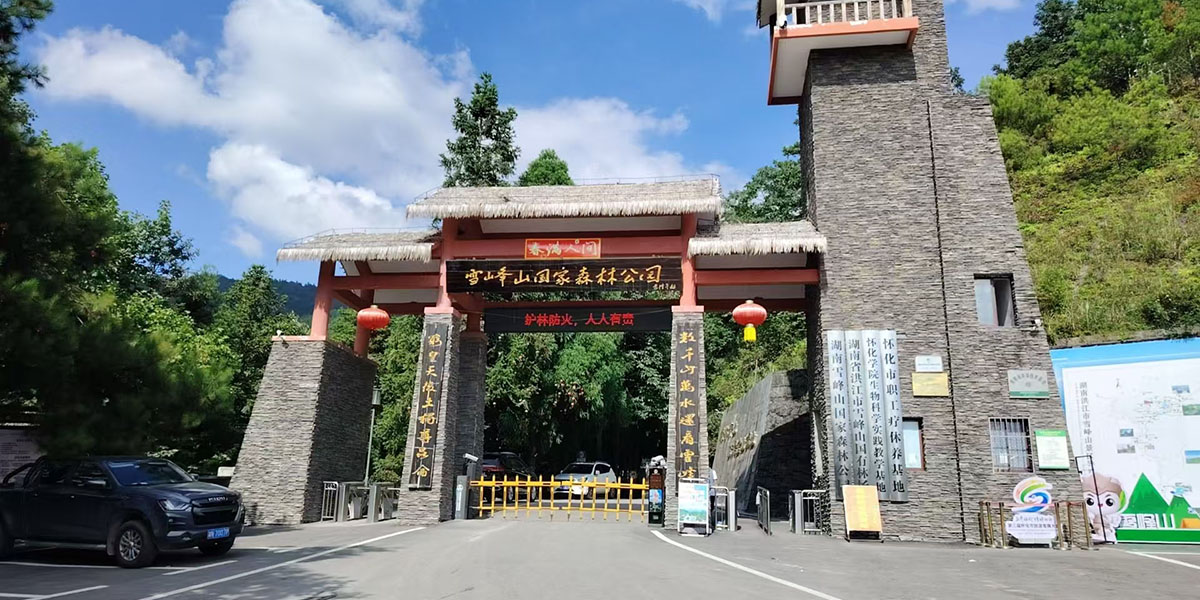
Introduction to Xuefeng Mountain
#Scenic Area News ·2026-04-18 02:05:12


Xuefeng Mountain is the southern turning zone of the second topographic step in China. Xuefeng Mountain is located in the southwestern section of the "primitive Jiangnan Ancient Land" and has an arc-shaped structure that protrudes from the northwest. Xuefeng Mountain is an ancient uplifted mountainous area with a positive structure. It starts from Dahanshan on the border of Hunan and Guangxi in the south, and its tail lies in the Dongting Lake area. It stretches for over 300 kilometers and spans 80 to 120 kilometers, featuring peaks and ridges over 1,000 meters long. Xuefeng Mountain belongs to the subtropical monsoon climate zone, but due to the influence of the high mountain area, it has the characteristics of "cold in winter and cool in summer, dry in winter and wet in summer". The Xuefeng Mountain area is crisscrossed by streams and rivers, with a dense water system. The water system is divided by the Badoupo Channel. The area to the north belongs to the Yangtze River system, while the area to the south belongs to the Pearl River system. The main soils in the Xuefeng Mountain area are yellow soil and yellow-brown soil. The forest vegetation has a relatively distinct vertical zone spectrum. It is located at the intersection of the Central China and South China zones and contains a considerable amount of components from the Guizhui-Guangxi zone, belonging to the mid-subtropical evergreen broad-leaved forest belt. The main and tributaries of the Yuan River pass through the Xuefeng Mountains and other surrounding basins, with a large elevation difference. This area is rich in hydropower resources. The minerals in Xuefeng Mountain include iron, manganese, antimony, tungsten, lead, zinc, copper, gold, etc.
In May 2019, hiking experts Leon McCarron and David Landis visited Xuefeng Mountain for the third time. After eight days of hiking and cycling, they planned a hiking route for Xuefeng Mountain that met international standards.
Chinese name: Xuefeng Mountain
Alternative names: Meishan, the southern section is called Xuefeng Mountain (folk name), the northern section is called Meishan (folk name)
The mountain range it belongs to: Xuefeng Mountain Range and Xuefeng Mountain Range
Geographical location: Located in the west-central part of Hunan Province
Direction: Southwest to northeast, with an arc shape
Length: 350 km
Width: 80 to 120 kilometers
Starting point: It begins on the north bank of the Wu River in Suining County, Shaoyang City in the southwest (south is the Great South Mountain).
Destination: Northeast to Yiyang County, which is now the urban area of Yiyang (with Dongting Lake to the north)
Main peak: Su Bao Ding
Haiba: 1934 m
Naming
1.
Modern Xuefeng Mountain
Narrowly defined: refers to the high mountains at the junction of Hongjiang (Qianyang), 溆浦, dongkou and longhui counties.
In a broad sense: It includes the mountain range system connected to it, namely the "Xuefeng Mountain Range" or the "Xuefeng Mountain Area".
2.
The time when place names were recorded in history:
The clear record of the name Xuefeng Mountain in historical books does not exceed a hundred years.
In ancient place name records, there are many "Xuefeng Mountains" in China, but there is no record of Xuefeng Mountain in Hunan Province.
3.
Legend of the Formation of place names:
Legend has it that Xuefeng Mountain got its name because there was a period in history when this area was often covered with ice and snow.
This might be related to the "Modern Little Ice Age" around the 17th century, when many parts of the Earth were covered with ice.
4.
Origin and Place Name evolution:
The "original place" of the name Xuefeng Mountain is in Hongjiang City.
The place name has undergone a process of evolution from the "primitive" Xuefeng Mountain to the "secondary" Xuefeng Mountain and then to the modern concept of Xuefeng Mountain.
5.
It was called "Meishan" in the Song Dynasty.
The "History of the Song Dynasty: Meishan Cave" records that Meishan Cave is a thousand miles long and roughly overlaps with the Xuefeng Mountain Range.
The name Meishan has existed since the Song Dynasty, and its geographical area is similar to that of Xuefeng Mountain.
6.
"Meishan" was previously called "Chushan"; :
In the poems of Wang Changling, a poet of the Tang Dynasty, the term "Chu Mountain" is mentioned, which is believed to possibly refer to Xuefeng Mountain.
The origin of the name "Chu Mountain" might be related to the legend of King Wen of Chu hunting.
7.
"Chu Mountain" was previously known together with Wuling Mountain as "Kunlun Mountain";.
The concept of ancient Kunlun is different from that of modern Kunlun Mountains and is regarded as a broader regional concept.
The "Ruo River" related to the ancient Kunlun Mountains is the Wu River, a first-level tributary of the Yuan River. Kunlun Mountain is located to the east of the Ruo River and is geographically close to Xuefeng Mountain.
The Kunlun Mountains may also include the Wuling Mountains, which are on par with the Xuefeng Mountains.
The Xuefeng Mountain in Hunan (in a narrow sense) and the Xuefeng Mountain Range in a broad sense are two different concepts:
In a narrow sense, Xuefeng Mountain, as a large secondary mountain range, starts from the north of the Wushui River in Suining County. It is divided into two sections, the north and the south, by the Zhexi Reservoir and extends northeastward to Yiyang County and Ningxiang County, forming a huge highland. The main body of this mountain range is located between the eastern part of Huaihua City and the western part of Shaoyang City, reaching Xinhua County of Loudi, Anhua County and Yiyang County of Yiyang City, and Ningxiang County of Changsha City. It is 350 kilometers long and 80 to 120 kilometers wide. Its name comes from the phenomenon that the main peak is covered with snow all year round.
In a broad sense, the Xuefeng Mountain Range encompasses Xuefeng Mountain and its branches and offshoots, including Dahanshan, Meishan, Jinlongshan-Tianlongshan, etc.
In contrast, the Luoxiao Mountains have an independent name and consist of multiple secondary mountains, each with a different name, making them easy to distinguish.
The southern part of Xuefeng Mountain is connected to the 80-mile-long Great South Mountain at the border of Guangxi and Hunan. It starts from the north bank of the Wu River in Suining County in the southwest and extends slightly in an arc to the northeast, ending in Yiyang County. To its east, a large branch extends, passing through Longhui County to Jinlong Mountain - Tianlong Mountain in Xinshao County, and then extending to Zhupo Mountain in Shaodong County and Shuangfeng County. The mountain range contains a group of folded block mountains. The Zishui River divides Xuefeng Mountain into a northern section and a southern section. The southern section is relatively steep, while the northern section gradually descends into hills after being cut through by the Zishui River. The main peak, Subaoding, is located between Hongjiang City and Dongkou County, with an altitude of 1,934 meters. The second highest peak, Bai Ma Mountain, has an altitude of 1,781 meters.
Climate
Xuefeng Mountain belongs to the subtropical monsoon climate zone, but due to the influence of the high mountain area, it has the characteristics of "cold in winter and cool in summer, dry in winter and wet in summer". The annual average temperature is 10.5℃ (data from meteorological stations), the highest annual temperature is 27.3℃, and the lowest annual temperature is -10.1℃. The annual precipitation is 1,780 millimeters (data from meteorological stations), and the average annual rainfall is 1,810 millimeters (overall data). It is rainy and foggy, with a relative humidity of over 87%. The foggy period lasts for 252 days, the annual sunshine duration is 1,144 hours, and the annual snow cover days are 19 days. The frost period is relatively long, with 247 foggy days throughout the year. The average freezing period is 55 days and the frost-free period is 293 days. The climate is influenced by the mountain range and presents different climatic characteristics as the altitude changes.
Terrain
Xuefeng Mountain, the watershed between the two different natural landscapes in the east and west of Hunan Province and the Yuanjiang River and the Zishui River. It is located in the west-central part of Hunan Province, at the southern turning point of China's second topographic step, and on the eastern side of the transition from the eastern slope of the Yunnan-Guizhou Plateau to the eastern side of the Jiangnan Hills. It is a rather unique geographical unit. Xuefeng Mountain is located in the southwestern section of the "primitive Jiangnan Ancient Land" and has an arc-shaped structure that protrudes from the northwest. The Pre-Sinian Lengjiaxi Group and Banxi Group, a set of strata composed of shallow metamorphic SLATE, metamorphic sandstone and phyllite, are widely distributed. The Sinian metamorphic clastic rocks are also well developed. There are outings among the strata composed of SLATE, limestone and fine sandstone of the Early Paleozoic Cambrian - Silurian. Due to the uplift caused by the Caledonian movement, a series of uplifts and depressions in the northeasterly to northeasterly directions were formed. Under the strong influence of the Yanshan Movement, a series of northeast-trending faults and folds occurred, further laying the foundation for the pattern of the Xuefeng Mountain's tectonic landforms.

Geology and geomorphology
Geology
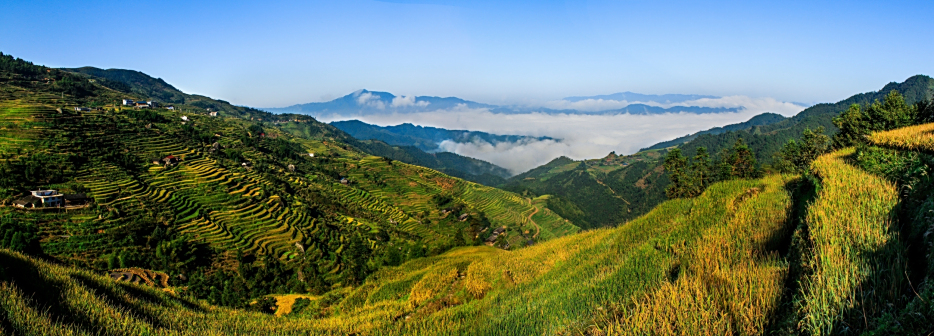
There is a large basin in Xuefeng mountain at 溆浦县, which starts from dizhuang town in the north and ends at tongmuxi township in the south. The county town is in the south of the basin.
Hydrology
River
Zishui: Its drainage area is 28,142 square kilometers, among which there are 39 first-level tributaries with a drainage area exceeding 100 square kilometers.
Lake
There are alpine lakes in the Xuefeng Mountain area, such as Xuefeng Lake located at a specific altitude.
Waterfall
Wangxi Waterfall and other natural landscapes are located in Longhui County, Hunan Province, and are a group of waterfalls in the Xuefeng Mountains.
Groundwater
Soil
"Biology"
Plant resources
The forest vegetation of Xuefeng Mountain has a relatively distinct vertical zone spectrum. The vegetation is located at the intersection of the Central China and South China zones and contains a considerable amount of components from the Guizhui-Guangxi zone, belonging to the mid-subtropical evergreen broad-leaved forest belt. Forest resources account for approximately 50 to 60 percent of the province's total In the primitive secondary forest areas such as nuo Stream (Dongkou), Bamian Mountain (Qianyang), Huangsang (Suining), Zhuchashan (Chengbu), Yunshan (Wugang), and Jiefushan (Xinning), one can see three-pointed fir, pot-flowered Nanmu, fragrant fruit trees, silver lotus, Taxus chinensis, golden leaf magnolia, Lidendron chinense, bright leaf water birch, five-needle pine, long-brined hemlock, ginkgo, Yunshan bell-calyx, Yunshan Linden, and Yunshan white Several endemic species and rare tree species in their seventies, such as orchid and silver fir. Under the forest, there are also a rich variety of fungi, mosses, lichens, ferns, herbaceous plants, etc. Among them, there are many economically valuable plants such as matsutake mushrooms, boletus, black fungus, ferns, kiwis, as well as medicinal plants such as Gastrodia elata, Ganoderma lucidum, Polygonum multiflorum, pinellia ternata, turmeric, ophiopogon japonicus, Gynostemma pentaphyllum, Houttuynia cordata, etc.
Animal resources